Showing posts with label hair loss. Show all posts

Friday, December 31, 2010

Why does one lose hair?


Hair loss has been associated with numerous myths and folklore tales, all which are based on superstition and ignorance. 


Everything under the sun has been blamed for hair loss including excess shampooing, daily washing, type of shampoo, use of hair dryer, type of soap, use of towel, the hardness or softness of  water, the geographical area where one lives, ethnicity, eating too few herbs, pooping once a week, eating too much meat, ogling excessively at the opposite sex, dandruff, your hormones, her hormones, sex hormones, not cleaning the backside after pooping and even excessive masturbation


In the majority of cases, the cause of hair loss is not known and is mainly due to bad genes and a lot of bad luck.

Sunday, June 14, 2009

Can finasteride (propecia) help my hair grow?

Finasteride is the generic name for the brand names proscar and propecia. Finasteride was initially marketed for treatment of enlarged prostate. However, during the clinical trials it was observed that some men complained of hair growth. The amount of hair growth during these trials was never quantified and in most cases was mild. This did not stop the drug company from turning the product around and marketing it for males going bald. There is both a 1 mg pill and a topical solution available for hair growth.

How Finasteride Works

Finasteride inhibits an enzyme in the body called 5 alpha reductase. This enzyme normally converts testosterone into the more potent androgen dihydrotestosterone (DHT). The company claims that the 1 mg pill can lower levels of DHT and help minimize hair loss. A lot of numbers are given by the company on the success of this drug in restoring hair.

So what is the real evidence?

If there ever was a scam, than this is it. Finasteride at best only grows a strand of hair here and there. There is not an individual on this universe that can step forward and claim to have decent hair growth following use of finasteride. Individuals have used finasteride for more than 5-10 years, and in the majority, the drug has done nothing. The drug is expensive and in 99.9999999% of individuals, it does nothing. In the other 0.000001% of individuals, they may get some pubic hair growth.

Therefore, the best advice for those who have loss of hair or baldness, get used to the condition or get a wig. There is no drug out there that will grow more than 1-2 hairs a year. Unfortunately, there is nothing in the drug market that works for hair growth. If you have no money and are going baldness, get used to that bald look, wear a hat or get rid of your mirror. If you have money and are going baldness, just enjoy life. Hair transplant is an option, but it is exorbitantly expensive and often does not work great. Baldness sucks especially when it occurs in the prime of your life, but I would rather be bald and have money, then be bald and having wasted all my money on a worthless drug.

Friday, April 10, 2009

What is telogen effluvium?

Some people start to lose hair all of a sudden and this type of non-scarring hair loss is often referred to as telogen effluvium. In the majority of cases, the hair loss is related to stress, a metabolic problem in the body or a reaction to a medication. Almost all individuals recover spontaneously within 4-6 months.

Telogen effluvium can cause hair loss on any part of the body, but it is hair loss on the scalp that is most obvious.

Hair grows in various cycles and the resting phase of hair growth is known as telogen. This resting phase usually lasts about 3 months but can vary few weeks on either side. During the telogen phase, the hair is already inside the hair follicle but has not yet pushed itself onto the skin At anyone point in time, about 10% of hair is in telogen stage. Whenever stress or a physical problem occurs, the telogen phase can be affected. The hairs which are expected to come out of the hair follicle, do not show up and a bald patch appears.

Telogen effluvium is quite common and many adults experience this hair disorder at some pint in their lives. The disorder is only of cosmetic significance and is not life threatening. All races, cultures and both gender can be affected.

Women tend to experience telogen effluvium more than men and this is most obvious just after pregnancy. Women and young adult males also are most alarmed by the hair loss and commonly seek some type of medical help.

Telogen effluvium can occur at any age but is uncommon in infants < 6 months)

Tuesday, February 17, 2009

IS there a Treatment for Hair loss? Part 1

Every drug, chemical postulated to cure hair loss, has in most instances been just that- a false claim prying on desperate men trying to counter an irreversible process. From drinking one’s urine to eating a tiger’s penis- all have been claimed to be the magical cure. And the drug industry does not fair any better. They are the biggest charlatans among them all.

The two drugs available today for hair growth, do little more than grow a hair here and there, and they are not only expensive but have to be applied or taken in orally for a life time- hair loss sure sucks.

The big question everyone wants to know “is there a treatment for hair growth?”. Unfortunately no. The medications available today may grow a hair here and there in a few people and that is about all the hair one will ever see.

Todate, there are no cure for hair loss. There are temporary solutions, some of which may help. For those with alopecia areata- one does not need any treatment as the hair will grow back sometime in future.

Monday, February 16, 2009

Coping with hair loss part 1

Losing hair is a miserable experience and one filled with anxiety, depression and loss of confidence. Hair loss typically occurs to males in their prime and is a very frustrating disorder to deal with. No matter what others say, hair loss is the Achilles heel of most men and coping is difficult. Many suggestions have been made to cope with hair loss and this includes joining a support group, discuss with family and friends and learn more about the disorder. Only time heals the pain of hair loss.

Conclusion


For those intent on having hair, the time to start drug therapy is when there is still some hair left on the head. For completely bald people, the options are limited to wigs and wearing a hat or accept a hairless scalp. Few insurance plans cover drug therapy and one needs to take the drugs forever to get the benefits and maintain them. The drugs are not cheap and there is no guarantee of hair growth. For a years supply, Rogaine may cost $200-$300 and Propecia can cost $700-$1,000. Neither of these medications is covered by any medical insurance.

Myths about Hair loss

Hair loss has been associated with more myths and folklore all which are based on superstition and ignorance. Everyone has an idea about how hair loss occurs. The internet is inundated with so called hair experts who speculate on why hair loss occurs.

Some of the nonsense speculated about why hair loss occurs include the following: Excess shampooing (esp. with head and shoulders shampoo), daily washing of hair, the type of shampoo, use of hair dryer, the type of soap, use of towel, the hardness or softness of the water, the geographical area where one lives, ethnicity, eating herbs, cleansing the bowels once a week, not cleaning the backside after poop and even excessive masturbation has been blamed on hair loss.

Like I mentioned before-bad genes, bad hormones and a lot of bad luck are the real answers to hair loss.
How does hair loss occur?

At any one point in time, the majority of hair on the scalp is in a growth phase anagen). This growth phase lasts anywhere from 2-6 years. About 10% of the scalp hair is in a resting phase (telogen) which lasts about 2-4 months. After this time, the hair is shed and a new cycle begins. Most individuals shed about 30-150 hairs everyday. After a single hair is shed, a new hair follicle replaces the same hair and the cycle begins again. Most hair grow at about 10 mm per month

In any individual who sheds hair faster than the hair regrowth, then baldness will occur. Initially the hair loss is gradual and then suddenly increases.
Types of hair loss

Hair loss is known as alopecia. The most common type of hair loss is known as male pattern baldness (androgenic alopecia). This is the most common type of hair loss in men and affects nearly 40-50% of males. The hair loss is permanent. The other type of hair loss is called alopecia areata- which commonly affects hair growth on different parts of the body besides the scalp and the disorder is temporary.

Two Major Causes of Hair Loss Part 1

Male pattern baldness (Androgenic alopecia)

Those individual who develop androgenic alopecia may experience hair loss as early as the early teenage years. The hair loss gets more progressive through the ensuing years and the results become more noticeable on the scalp. The hair loss typically begins at the temples and crown. The end result of the hair loss is partial or complete baldness by the 30s to early 40s. This is an irreversible process-permanent.

The androgenic variety of alopecia has a familial connection but the actual pattern of genetic inheritance remains unknown. This type of hair loss is common in both males and females, but females rarely go bald. If anyone in the family is bald, then one can rest assured that other male members of the family will have the same unfortunate event occur sometime. In most cases, when there is male pattern baldness in the family, the hair loss typically occurs at a much younger age and a lot faster.

Alopecia areata

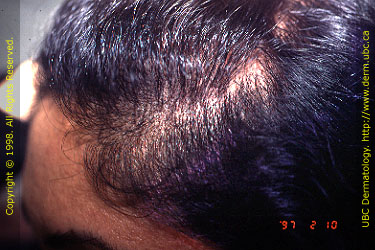
Alopecia areata is associated with temporary hair loss from the face and other areas of the body. The condition happens suddenly and results in patchy hair loss. The hair loss may be on the face or parts of the scallop. The area becomes completely devoid of hair follicles and appears smooth and white.

The cause of alopecia areata is unknown. But there are many speculations. Some claim that it is related to stress, a viral infection and other claim that it is autoimmune (your own body’s cell react and kill the hair cells) or bad luck. The hair loss occurs suddenly and most men are in good health and young.

It is not known if there is a genetic link with alopecia areata. The good thing about the disorder is that the condition is temporary and the hair does grow back. In most cases, the hair loss persists for a few months and then all of a sudden the hair reappears. The condition can recur a few times.